
A Clearer View of Property Investing in The Gambia
Buying a property is a significant decision. When you intend to rent it out, generate income or hold it as a long-term investment, the questions go well beyond location, appearance and purchase price.
What could the property earn? How much will ownership actually cost? What happens during periods with fewer bookings? How will your payment schedule and personal use affect your returns? And what might the overall investment look like after five, ten or fifteen years?
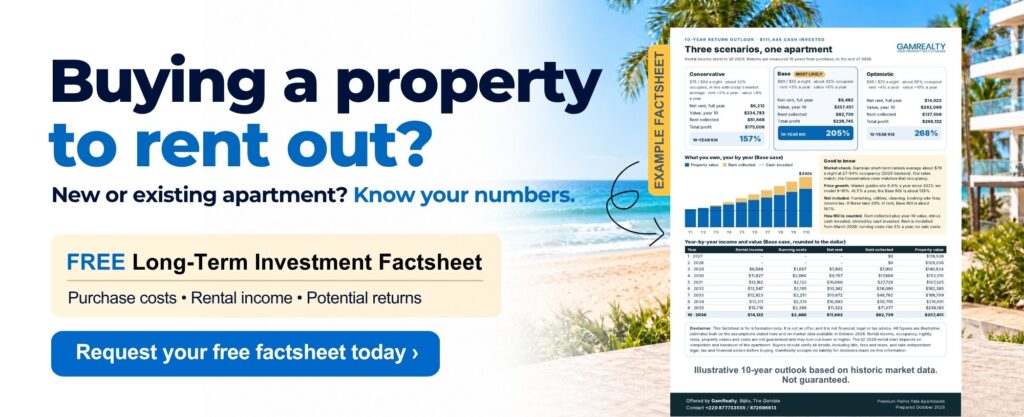
These are the questions behind GamRealty’s Free Investment Report—a personalised analysis, powered by EstateLogix (a fully fledged SaaS product), included for clients purchasing a qualifying property through GamRealty.
Why we offer this service
Through our work with property buyers and investors, we regularly hear the same question: “What return can I expect?”
Answering it properly requires more than quoting a rental rate or a percentage. A property might attract a good nightly rate but have substantial operating expenses. Another might generate less rental income while requiring a smaller initial investment. A payment plan can also change when your money is committed and when income begins.
We developed EstateLogix to bring these variables together. It allows us to model an investment using clearly stated assumptions and explore how changes affect the results.
By offering this service to qualifying GamRealty buyers, we help them understand the financial side of ownership and plan beyond the purchase itself.
Understanding the full cost of your investment
The advertised apartment price is the starting point. Depending on the property and your plans, your investment may also include acquisition expenses, furnishing, equipment and the cost of preparing the unit for rental.
Ownership brings recurring expenses too: management, maintenance, service charges, insurance, booking fees and replacement of furniture or appliances.
A useful investment analysis identifies which costs are included, which are estimated and which still require confirmation. The aim is to give you a clearer view of the money you commit and the income you may retain.
Rental income: looking beyond the nightly rate
A nightly rental rate does not tell you how much a property will earn in a year. Occupancy matters, as do seasonal pricing, the rental strategy and the days you reserve for your own use.
Your report can compare different scenarios, such as lower occupancy, a base case and a stronger rental outcome. It can also explore short-stay rentals and longer rental periods where suitable information is available.
This helps answer practical questions. What happens if bookings are below expectations? How much income do you give up by using the apartment yourself? Would a longer tenancy produce a more suitable balance of income and expenses?
The purpose is to understand a range of possible outcomes and the assumptions behind them.
ROI: understanding your overall return
Return on Investment, or ROI, expresses profit relative to the amount invested.
For example, if an investment of $100,000 produces a total net profit of $40,000 over the period being assessed, its ROI is 40%.
The period matters. A 40% return over five years is different from the same return over fifteen years. It is also essential to distinguish annual rental yield from total investment ROI, which may include rental income and a gain or loss on an eventual sale.
Your report should make those distinctions clear.
IRR: understanding the timing of your money
Internal Rate of Return, or IRR, considers both the amounts and timing of money paid into and received from an investment. It expresses those cash flows as an annualised rate.
For property buyers, this is particularly relevant when payments are made in instalments, rental income starts later or a future sale forms part of the investment plan. Receiving income earlier can produce a different IRR from receiving the same amount much later.
IRR adds a useful perspective, but it remains dependent on the projected cash flows. An assumed resale price can materially influence the result.
MOIC: understanding the total value relative to your investment
Multiple of Invested Capital, or MOIC, shows total investment value relative to the capital invested.
A multiple of 1.5× means total value equal to one and a half times the invested capital, including the original capital—not a profit of 150%. The report must state whether this includes estimated property value or sale proceeds, and whether costs have been deducted.
MOIC does not account for how long the investment takes. That is why it is useful alongside IRR: one describes the multiple of capital, while the other considers cash-flow timing.
Cash flow: what ownership could mean year by year
Alongside these return measures, the report looks at projected cash flow: the money coming in and going out over time.
This helps you see whether rental income could cover operating expenses, when additional funding might be needed and how costs affect the income available to you.
For a long-term investment in The Gambia, the model should also make assumptions about future rental rates, expenses, currency and resale value explicit. Property appreciation should be explored as a scenario, rather than treated as a certainty.
An exclusive GamRealty buyer benefit
The personalised Investment Report is included at no extra cost once you have confirmed your decision to purchase a qualifying unit in a participating development through GamRealty.
At the enquiry stage, we can explain the service, discuss your investment objectives and confirm whether the property you are considering qualifies.
Our purpose is to give buyers a more useful understanding of their investment: how it could generate income, what ownership could cost and how its financial performance may develop over time.
Contact GamRealty to learn more about qualifying developments and your Free Investment Report.
All projections depend on stated assumptions. Actual rental income, expenses and resale values may differ. The report supports financial planning; it does not guarantee returns or replace legal, tax or property due diligence.